Driveways, patios, sidewalks and pool decks. Flat concrete collects everything North Texas puts on it, and the driveway is the first surface every visitor crosses on the way in.
Driveway and concrete cleaning is the removal of the oil, tire marks, rust and organic film that build up on flat concrete, from the driveway to the patio, sidewalk and pool deck. Standard Power Washing cleans open concrete with a rotating surface cleaner instead of a handheld wand, which is how the finish comes out even.
The driveway is usually the largest stretch of concrete on a residential lot and the first thing anyone sees from the street. It also collects the widest mix of problems: tire marks where cars turn in, drips under wherever the car parks, orange fans of rust from the sprinkler heads along the edge, and the green-black film that grows on any section the house or a tree keeps in shade.
Plain broom-finish driveway concrete can take real pressure and heat, and a rotating surface cleaner is what keeps the finish even from the garage to the street. Rust from irrigation water is a mineral deposit and gets its own remover. Oil that has soaked in gets pointed out and quoted as its own treatment when we look at the job, because pressure on its own lifts only part of it.
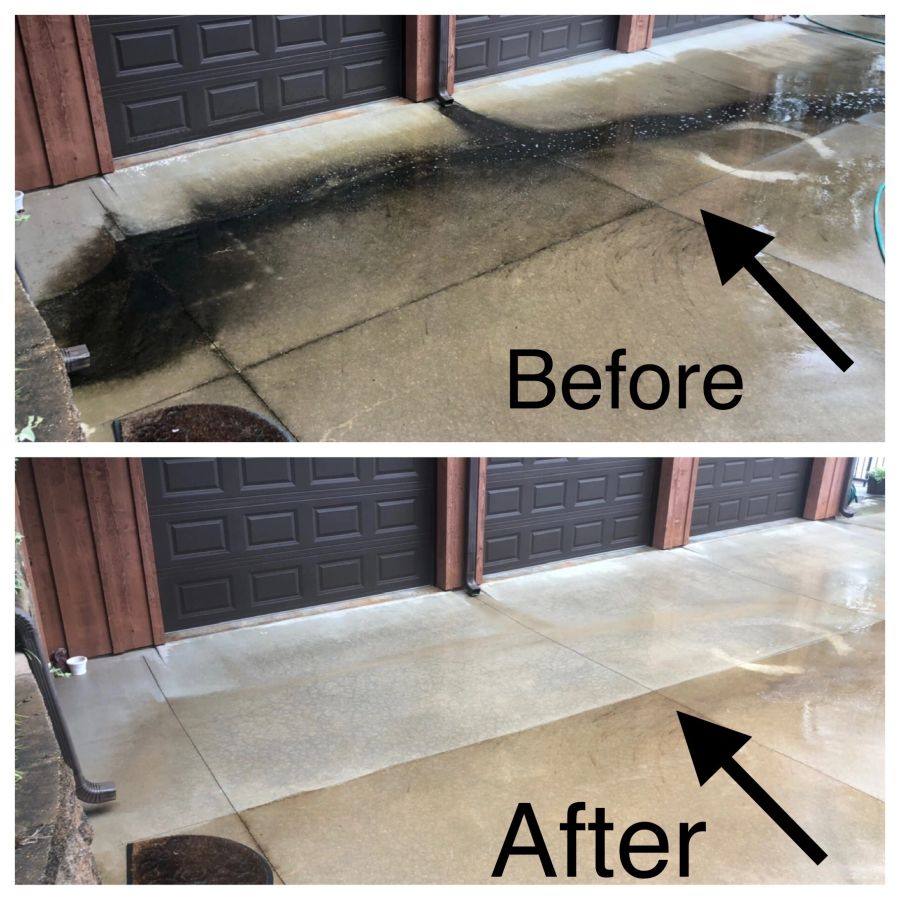
A garage apron, before and after.
Patios, sidewalks, and pool decks
These three get grouped together because they are the same material with three different problems. A patio sits under furniture and trees and spends half its life in shade. A sidewalk takes constant foot traffic and is the piece of the property the street actually sees. A pool deck is wet, chemically loaded, and usually finished with something softer than the slab beneath it.
The cleaning method is the same family of work. The pressure, the dwell time, and the amount of care around the edges are not.
What is on a dirty driveway?
Mostly three things rather than loose dirt: organic growth, traffic grime pressed into the surface, and stains from rust or tannins, and each one comes off a different way.
Organic growth: algae and mildew in anything shaded or slow to dry. It is alive and rooted into the pores, which is why hosing it does nothing and why it returns faster each year.
Embedded traffic grime: oil, tire residue, and general road film pressed into the surface over years. This is the part that needs mechanical cleaning rather than a solution.
Staining: rust from irrigation water and fertilizer, and tannin bleed from leaves, mulch, and anything organic left sitting on the slab.
Reading which one you have before starting is most of the job. Treating a rust stain like algae wastes an afternoon and leaves the stain.
A surface cleaner, not a wand
The most common complaint about cleaned concrete is stripes — the faint zebra pattern that appears once the slab dries. That is not a stain. It is a record of how the concrete was cleaned.
A handheld wand throws a narrow fan of water. Every pass depends on the operator holding the same height, angle and walking speed as the last one, and nobody does that consistently across four hundred square feet. The overlaps clean slightly more than the middles, and the difference is invisible while the slab is wet and obvious once it dries.
A rotating surface cleaner solves it mechanically: bars spinning inside a fixed housing, held at a set height, covering a consistent width. The result is an even finish rather than a striped one, and on open concrete it is faster than a wand.
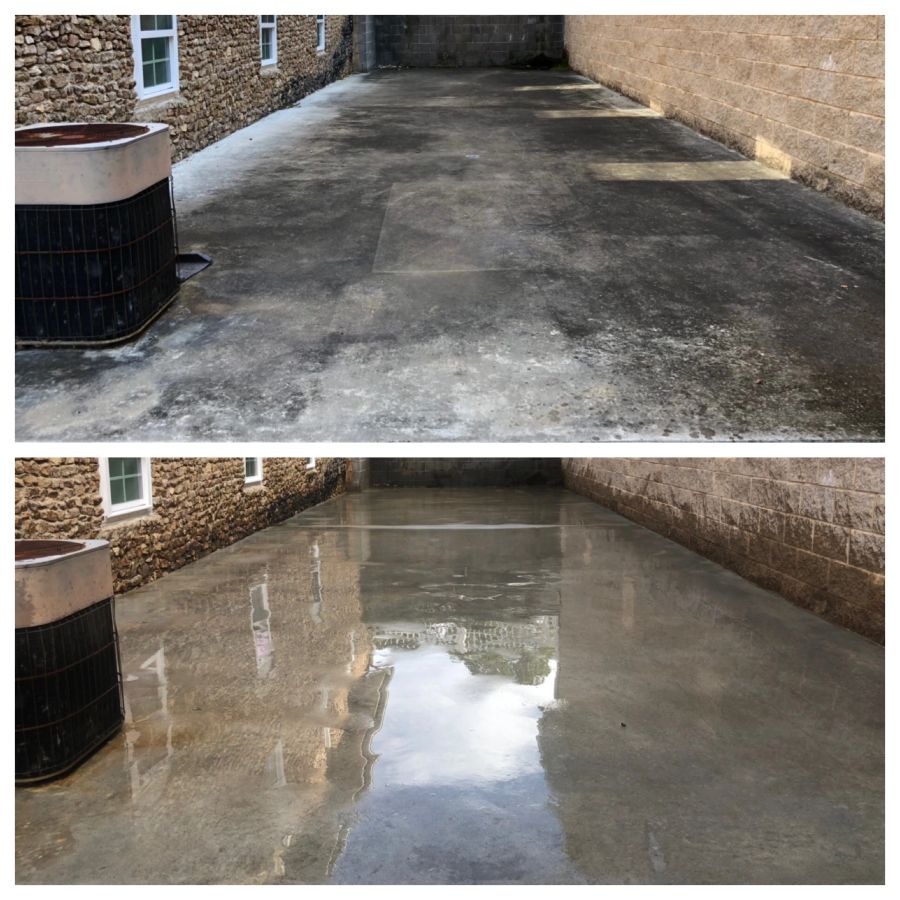
A concrete slab, before and after.
How we clean a driveway
Read the stains: growth, ground-in traffic grime and mineral staining each need a different treatment, so we identify which ones are there before starting.
Treat what pressure will not lift: irrigation rust gets its own remover, and oil that has soaked in is pointed out and quoted separately.
Set pressure and heat to the finish: broom-finish driveway concrete takes far more than stamped, textured or coated concrete does.
Clean with a surface cleaner: the rotating head works the slab from the garage to the street for an even finish without wand stripes.
Pool decks are their own problem
Most pool decks are not bare concrete. They are textured, coated, or finished with a cool-deck product that is deliberately softer and more porous than the slab it sits on — that is what makes it walkable barefoot in July. It is also what makes it easy to ruin.
Pressure that is perfectly safe on a driveway apron will lift that texture off in strips, and once it is gone the only fix is recoating. Deck work runs at lower pressure, and the rinse is directed away from the coping so the volume reaching the water stays controlled.
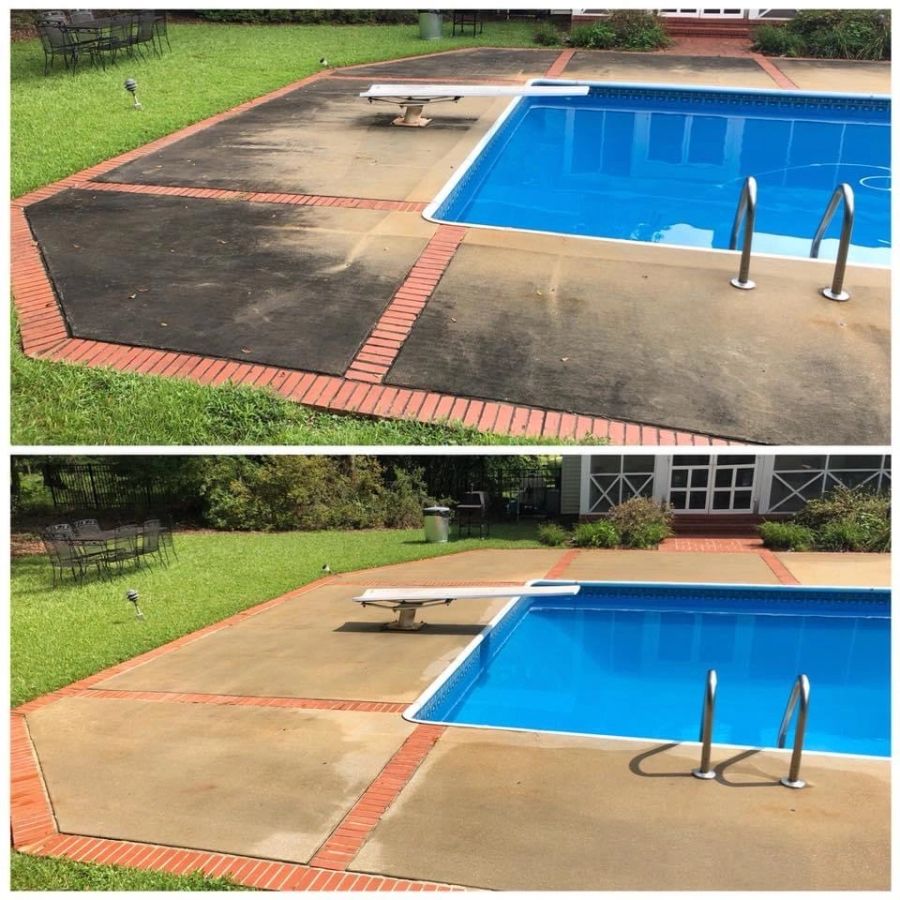
A pool deck, before and after.
Sidewalks and anything the public walks on
Public-facing walkways are judged differently from a back patio. Darkened concrete at an entrance reads as neglect before anyone reaches the door, and on commercial frontage it sits directly beside whatever the neighboring tenant has or has not done. Gum, drink spills, and the traffic darkening that creeps in from the parking side all live here.
For multi-tenant frontage this usually belongs with a storefront cleaning visit rather than a separate trip, and where there is a lot at the other end of it, with parking lot striping.
How often each surface needs it
How often each concrete surface needs cleaning
Surface
Typical interval
What sets the schedule
Driveways, patios and sidewalks
About once a year
Shade, and how fast the slab dries after rain
Shaded, north-side or under-tree concrete
More often than once a year
Held moisture lets organic film grow back faster
Busy walkways and public frontage
Set by use rather than the calendar
Foot traffic darkens them on its own schedule
House siding, brick and stucco
Every 12 to 24 months
The shaded elevations regrow first
Where we work
We clean driveways and flat concrete in Fort Worth, Benbrook, Aledo, Weatherford, Burleson, Crowley, Mansfield, Keller, Saginaw and Haslet. Owner-operated and fully insured, we have completed more than 500 jobs since 2022.
Fort Worth is part of the coverage too; every town is listed on the service areas page.
Driveway and concrete cleaning FAQs
Will pressure washing damage my concrete?
Concrete is durable but it is not immune. Too much pressure, held too close or too long in one place, etches the surface and leaves a permanent mark. Plain broom-finish driveway concrete takes far more than stamped, textured or coated concrete does, so the pressure is set to the surface rather than to the machine's maximum.
Why does my driveway have stripes after it was cleaned?
That is wand striping, also called zebra striping. A handheld wand sprays a narrow fan, and the operator's distance and speed change with every pass, so the overlaps show once the concrete dries. A rotating surface cleaner holds a fixed width at a fixed height, which is what gives an even finish.
Can you clean a pool deck without getting cleaner in the pool?
Yes. Rinse is directed away from the water and the volume is controlled at the coping, which is where most runoff would otherwise enter. Pool decks also need less pressure than they usually get: textured and cool-deck coatings are softer than the concrete underneath, and the pressure that cleans a driveway will take the texture off.
How often should concrete be cleaned?
Once a year suits most North Texas properties. Concrete that stays shaded, sits on the north side, or holds moisture under trees grows organic film faster and benefits from more frequent cleaning. High-traffic walkways and anything the public uses tend to darken on their own schedule.
What drives the price of driveway and concrete cleaning?
How much concrete there is, what is on it, and how easy it is to reach. Soaked-in oil is quoted as its own treatment, and adding a patio, sidewalk or house wash to the same visit costs less than separate trips. Estimates are free and usually go out the same day.
Free estimates
Get your concrete back to even
Call or email with your address and roughly what needs cleaning. Most concrete quotes go out the same day without a site visit.